
For me, as probably for many people, procrastination can be paralyzing. Isn’t there always something more tempting, more engaging, to do than the task that’s nagging at the back of your mind?
As much as I love writing— as much as it takes me away and is pure escapism— when I decided in earnest to write my second novel, I was constantly faced with so many reasons not to. Although the concept for the book had been born decades ago, the first few chapters grew dusty on my laptop through different seasons in my life. There those few thousand words sat, as silent teasers, constantly taunting me to move forward. But there was always a friend to lunch with, a dishwasher to unload, a child needing attention, a nap to take, a linen closet to reorganize.
Although my avoidance of the unfinished manuscript was due mostly to laziness and procrastination, there was also a healthy dose of fear involved. What if I sat before the screen and no words came? What if what I wrote was horrible? What if my first novel was a one-of-a-kind phenomenon and I didn’t truly have any more stories inside me? I doubt any of these feelings are unique; such is the mindset, I believe, of most writers. Angsty self-doubt is our constant companion.
Finally, I realized that the only way to move forward was to discipline myself, as I did in completing Mt. Moriah’s Wake, to set a time every week to devote to writing. The problem was, at this time in my life, I had a very demanding 60-hour-a-week job that occupied a good bit of my weekend time and all of my weekday hours. So, I decided to look at the task in front of me in terms of words, not time.
I set as my goal to write 1,200 words a weekend.
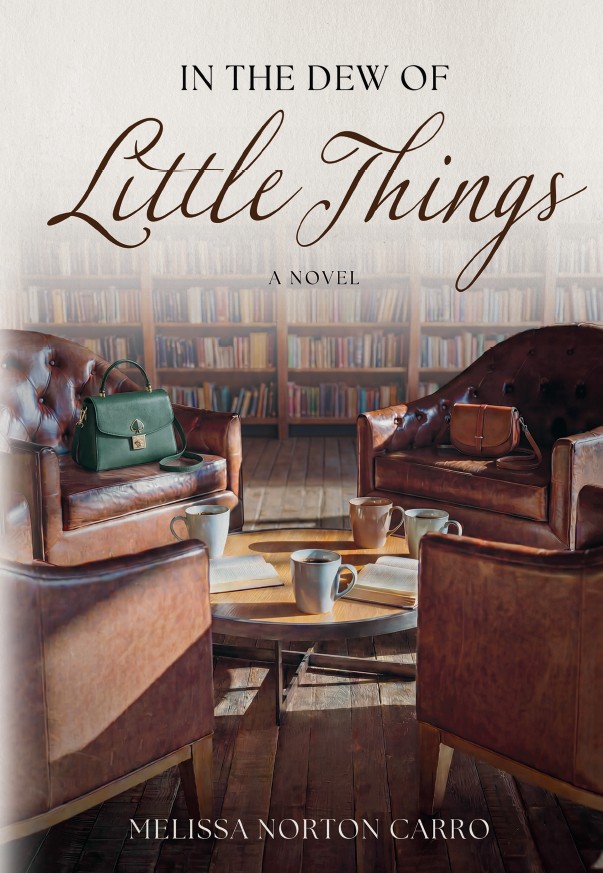
My new novel, In the Dew of Little Things, was therefore written 1,200 words at a time. To put that in perspective, the finished product is just over 100,000 words. That’s a lot of weekends—quite the slow-moving train.
There were weekends when I over-achieved and ended up with 3,000 words and weekends when I was searching for adjectives to add just to achieve my 1,200-word goal. There were weekends when the characters took over, surprising me with what they did and taking me away, and weekends when I stared at the screen, dreaming of being anything but a writer.
Ironically, or perhaps intentionally, my inherent self-doubt feeds into the novel’s narrative, as it focuses on four women (and, secondarily, their husbands and children) who become somewhat unlikely friends. Each faces her own brand of self-doubt through the issues ubiquitous to most women: physical appearance insecurities, crippling worry over finances, marital strain, challenges in caring for children and elderly parents, health scares. Each of the women is on her own unique journey through life, facing the struggles and triumphs that I believe exist for most women at some point in their lives.
The final project is an homage to friendship and, specifically, to female friendships. I intentionally wanted the book to not be about best or lifelong friends. If we’re lucky, as women, we all have those people in our lives who are more sister than friend. I have a few, and they know who they are. Rather, I wanted to write about the people who pass through our lives—each contributing a tiny but vital square in our life quilt. There are so many people who have friended me on my different journeys through life. Although I don’t think of them every day, they are always in my heart, and their impact is immeasurable.
The female publisher who first bought the novel paid me the greatest compliment I’ve ever received as a writer: “You made me feel seen.”
So, is this a book men shouldn’t read? On the contrary, my hope is that In the Dew of Little Things will give men a glimpse into the female psyche, and many of the experiences described are universal. I have intentionally treated the male characters with the respect they deserve, because—through personal experience—I have come to believe most men are decent and honorable. But I cannot write through the lens of a man because I don’t know how they think (God knows I’ve spent years trying to figure that out!). Long ago, in a college fiction course, I wrote a short story about a jock named Jake. The story bombed. My brilliant, kindly professor, peered over his glasses at me and asked, “You ever been a high school boy?” When I shook my head, he said, “Write what you know.”
I don’t know much, but I do know what it feels like to be a woman, and I do think our journeys are unique, and friendships—the bonds of motherhood and sexuality—are critical to our thriving in each gloriously challenging decade of our lives.
Perhaps the fact I had to write the book 1,200 words at a time is a metaphor for our lives. To look too far down the road is overwhelming; we have to endure, thrive, live 1,200 “words” at a time. As one of the characters says in the book, “Sometimes we just have to get through the day.” Our journeys are equal parts miraculous and exhausting, heartbreaking and exhilarating. I wouldn’t trade being a woman and my life’s journey for anything—and I will always treasure the 1,200 words of solace I received once a week during a hectic time in my life.
In the Dew of Little Things—coming August 2026 to Amazon and a bookstore near you: I hope you’ll share the news and put it on your to-read list.
Most of all, I hope it makes you feel seen.


Melissa, this book sounds amazing. I love my female relationships and thank God every day for those bonds. I look forward to reading! Margaret
LikeLike
I am 100% male, and love this story. Yes, it shone a light on the female psyche. But I believe there are universal ungendered truths about friendship, that Mel captures beautifully. Mel is one of my favorite writers and I hope that becomes true for you too!
LikeLike