
In early June, my husband and I spent two weeks in Italy. I was astonished at the antique worlds I found myself in. We visited Herculaneum and Pompeii, Rome’s Trevi Fountain and the Colosseum and Forum. We walked through Pompeii, marveling in the shops and houses and streets that once housed a citizenry. We saw Galileo’s and Michelangelo’s tombs and stared upward in awe at St. Peter’s Basilica. I stumbled upon Keats’ house—and the bedroom where he died—only a few yards from the Spanish Steps. We took a boat in Capri around the Bay of Naples and held our breath as the captain steered us through the narrow passages. We gazed in awe at the Duomo Cathedral in Florence.
Just when we thought we couldn’t see a more beautiful piazza or cathedral, we did.
Because it is the Jubilee Year (or Holy Year) in Italy, the streets were crowded, and because it is summer, we were hotter and more dehydrated than I ever thought possible. Although a fascinating trip, it was also grueling—and nothing more than our hikes up to Villa Jovis (Emperor Tiberius’s villa) in Capri and our climb to the top of Mt. Vesuvius, overlooking the Bay of Naples. Each climb was about 1.25 miles, and given the steepness, we moved slowly.
Although we felt our age, we made it, and, miraculously, no defibrillator was needed.
In the months leading up to our Italian adventure, I had been stressed, overworked and fatigued, and plagued by a contemplative mood. I had set aside writing and even reading. Rather, I found myself lost in music, taking long walks, taking stock of my life, my marriage, my future. I felt lost and unsure how to find myself again.
Perhaps, I’m having a (post) mid-life crisis. Perhaps what I needed was to be thousands of miles away.
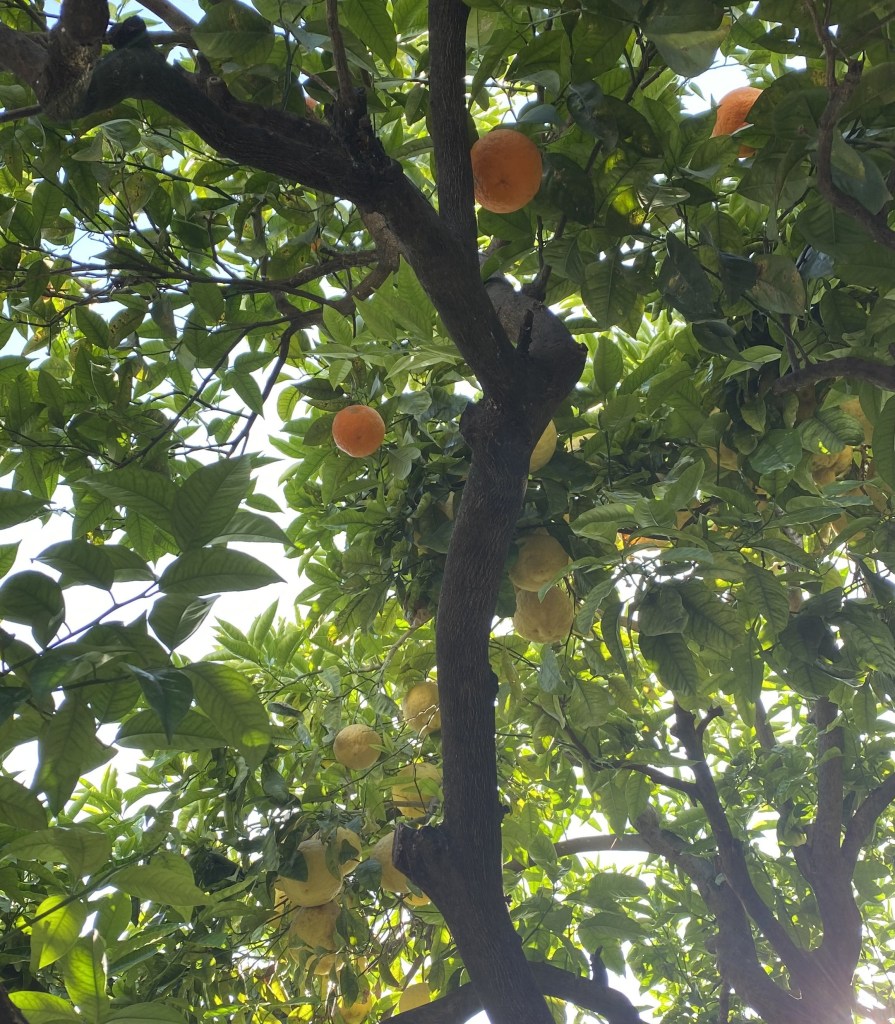
It wasn’t just the Italian history and architecture that captivated me, but the nature. One morning, breakfasting on a terrace, I looked up into the lemon tree above me. To my surprise, I discovered branches with oranges intermingled.
Ignorant to agricultural processes, I didn’t know that this is due to a man-made process called grafting that involves inserting a single bud into the tree’s rootstock. From that one small event comes a marriage of the two citrus fruits—making for a delightful overhead shade.
It occurs to me that the process of grafting is not so different from the man-made construct of marriage: A small event—a first date, a first kiss—can set in motion an entire world that didn’t exist before.
There is no one I’d rather be with than my husband and perhaps especially on a 14 percent mountain grade in 90 degree weather. Honestly, though, while hikes up those Italian mountains were physically stressful, they were no more challenging than the emotional climbs we’ve done together. Jobs—those new and those lost—raising children, financial difficulties, tending to elderly parents, grief—each milestone has had its own mountain grade. And through each, we’ve pushed through as we did in Italy: keeping pace with each other, pausing when needed, pulling each other along.
But lately it seems we’re climbing different mountains; we have reached the age where our lives are bearing different fruit. My husband, nearing retirement, can taste sweet freedom, while I’m very much consumed with the job at hand, tangy as it is. I find it hard to slow down long enough to let quietude wash over me.
To figure out who I am alone.
Recently, I’ve been talking with women my age about the phenomenon of feeling unseen. I find myself—perhaps all women do at this age—overcrowded, drowning in the needs of others—colleagues, friends, relatives. It is intrinsic in our DNA to listen, to give and repair, rinse and repeat.
How easily we lose ourselves in the foliage around us.
Had I not looked more closely up into that citrus tree, I might have only seen one fruit. It makes me wonder, question, if my life is so deeply interwoven with my husband, my children, my work, that a single exquisite fruit cannot shine alone.
And yet, deep down inside, I know that’s not true. Although a singular citrus tree is a sight to behold, the grafting of two trees provides a powerful canopy that offers life-saving breezes. Perhaps it’s the same in human relationships. As our lives are grafted together, we don’t cease our individuality. We’re simply more complex. And stronger.
Sometimes it takes mountain hikes and ferry boat rides in the Italian Riviera to remind us that we don’t want to go it alone. That we’re better, stronger, because our tree has married its roots to another. That it’s okay to need someone to push us up the steep hill and sit silently beside us in the aloneness we feel.
That as impossible as it is to tell where one tree stops and the other begins, therein lies the magic.


This was a particularly good one. ================= Nancy Thompson 615-417-7480
LikeLike