
Earlier this year I had to have an infected tooth pulled. This created a hole in my mouth that became a constant source of fascination to my wandering tongue. I discovered that, in times of stress or anger, instead of biting my tongue, I could simply slip it into that crevice. The hole became familiar, comfortable.
Then came the decision of whether to get an implant. I found myself hesitating, not due to finances or fear of pain. Instead, it was a matter of sheer apathy. I had lived with the hole for so long that it no longer seemed to be an oddity; rather it was just part of me.
“You can’t just walk around with a hole in your mouth,” friends and family would say.
Oh, but I could. Holes are like that… some stay with us so long and go so deep that filling them seems futile, even daunting.
About the time that I was debating whether to get an implant, I became aware of several friends who seemed to be falling ever more deeply into abysses of grief. Their pain, each one unique, became comfortable holes, almost friendly companions. Like my tongue searching for the little space between my teeth, they sought that grief like a pillow on which to lay their busy bodies.
It’s easy to fall into holes. Not so simple to fill them. And it certainly takes effort to acknowledge the holes with which our friends are struggling to cope.
Recently my pastor and I were ruminating over why empty nesters often stop or reduce their church attendance. I know my own attendance has lapsed. No longer are there children to get dressed and drive to church; many church activities that focus on the family seem to lose relevance as we age. And Sunday mornings suddenly begin to feel like mini vacations: spaces of time in a week that we never knew we had.
Then, in November, I attended the All Saints’ Sunday at our church. It’s one of my favorite Sundays, because there’s something cathartic about sitting in the space of grief. I relish thinking about the people who have gone before, the ghosts of good people whose spirits built, and still whisper through, the sanctuary. Sitting in quiet meditation, letting the music swell around me, hearing words of hope: all of these filled a hole I didn’t know was there.
You see, that’s the sneaky thing about holes. Sometimes you don’t realize they exist until something fills them.
My college reunion took place a few weeks ago, and spending time with people I’ve known since I was 18 made me perceive holes in my heart that only they can fill: spaces into which I’ve stuffed work and new friends and the busyness of life. But the craters were still there: chambers of my heart waiting to be reinhabited by old friends.
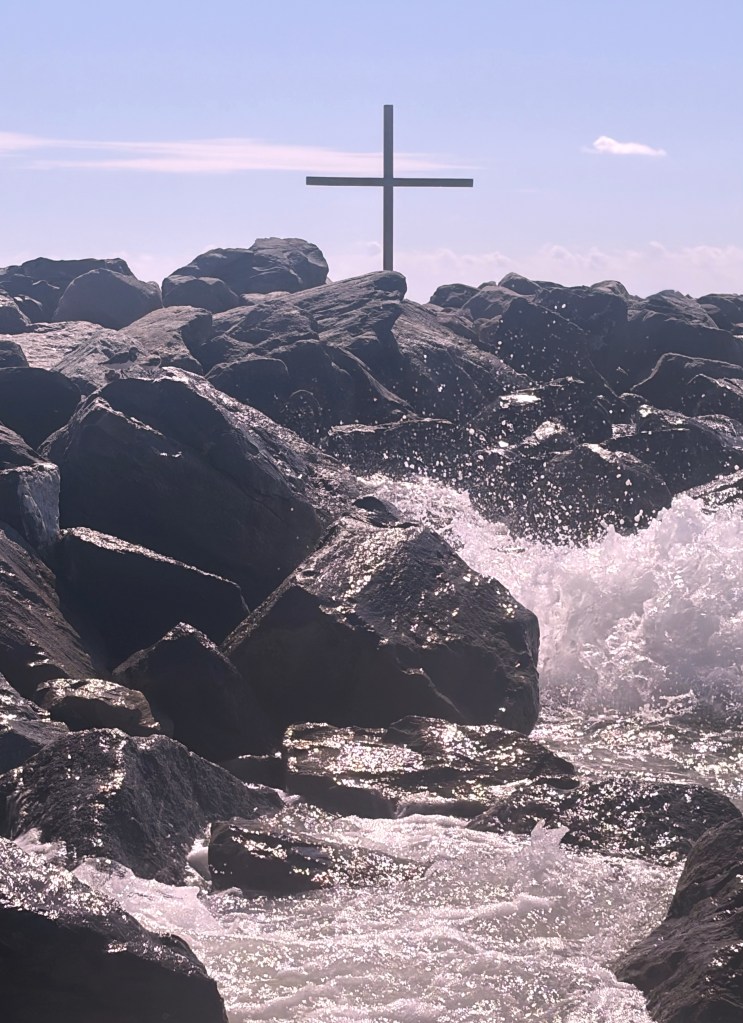
In October my husband and I went on a short trip to the beach and each day walked down to a rocky headland. Perched on its highest point was a rudimentary cross. The scene was striking, and I took scores of photos of it, but in each photo there was a flag, or a boat, or a rock climber. Eventually, I figured out that, with my new iPhone, I could use the “clean up” tool to remove unwanted objects, and, just like that, the cross presented itself as the dramatic image I was seeking.
If only I had a clean up tool for my life.
Take writing, for instance. For me, there’s always a reason not to write, always something that pulls at my attention. But creating words on a page recharges my dead batteries . As I begin to plow through the edits of my new novel, I find myself understanding that, for me, writing fills a void that nothing else can.
It occurs to me that perhaps before filling the holes in our hearts—holes created by hurt or betrayal or grief or loss—we need to clean up the clutter from our lives. Before we can recognize the simplistic beauty of a cross on the rocks, we need to divest ourselves of the distractions that distance us from meaningful work, from the power of friendships, from family and faith. How often do we simply sit quietly and breathe in and out? Perhaps we need to attend church services not because we have the time but because we don’t. Maybe we need to linger in the company of family and friends not because we have nothing else to do, but because we have so many other things to do that are less important.
My mouth is now sporting an implant. Donated cadaver bone merges with my jaw bone to create a stable environment for my eventual new tooth. Perhaps the message of Thanksgiving is not only to give thanks for the fullness of our lives, but to believe that the cadaver bones of grief and loss and despair—the holes that we bear on our hearts—can be filled. Will be filled. By people, by hope, by faith.
If only we get our tongues out of the way.
Happy Thanksgiving!

 IN THE MIDDLE